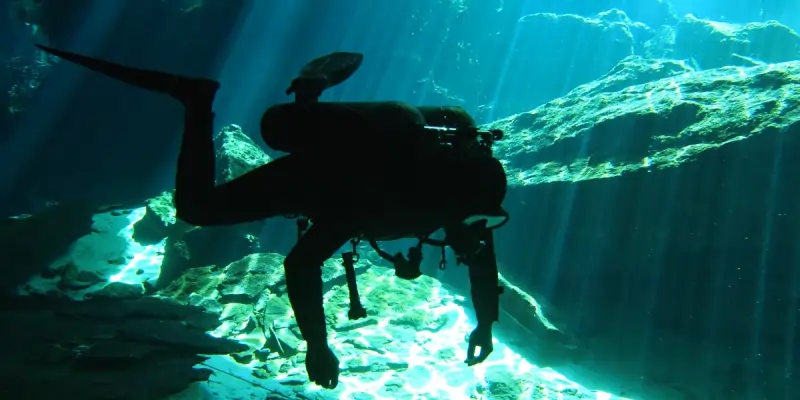
People ask me all the time: if I only have one day, one cenote, which one do I choose? For divers with some overhead-environment experience who want to see everything the cenote world has to offer — light beams, a halocline, ancient fossils, a jungle-green entrance — I tell them Chac Mool. Every time.
Two Cenotes, One Dive Day
The first thing to understand about Chac Mool is that you’re really diving two connected cenotes in a single outing. You enter through a passage nicknamed “Little Brother,” and from there the route connects Cenote Chac Mool with Cenote Kukulkan — with the option to complete one dive in each during the same day. Unlike some of the narrower cave systems in the area, Chac Mool is wide and open, giving you more room to move and better sightlines on the formations.
The Chac Mool Halocline
When people talk about haloclines in the Riviera Maya, most divers think of Angelita first. But Chac Mool has its own, and at a maximum depth of just 12.5 meters, it’s far more accessible. Fresh water sits near the surface, fed by underground rivers; deeper down, salt water from the Caribbean has seeped in through the limestone. Where the two meet, the difference in density creates a blurry, shimmering boundary layer — disorienting and beautiful at the same time. There’s a temperature shift too, so your body registers the crossing before your eyes finish processing it.
Kukulkan: Light Beams and Ancient Coral Fossils
The Kukulkan section has a side opening that lets sunlight enter at an angle underwater photographers spend years chasing. On a clear morning, beams cut through the water and scatter across the rock formations. Kukulkan isn’t just about light, either — millions of years ago this limestone was a coral reef, and its walls still show shells, coral fossils, and imprints of ancient marine life.
The Little Brother Entrance
The entrance through “Little Brother” is one of the more quietly spectacular moments in cenote diving. You drop through a narrow passage and the cavern suddenly opens into a vast, glowing green arch — jungle roots and boulders pressing in from above, light filtering down in thick green sheets.
Certification Level Required
Chac Mool offers two routes depending on your certification:
- Cavern route: Open Water certification is enough
- Cave route: requires Full Cave certification
What to Expect
- Approximate duration: 40 minutes
- Water temperature: consistent year-round, 24-25°C
- Visibility: high, except for temporary sediment disturbance
- Group: guided dives with a certified instructor
Frequently Asked Questions
Do I need previous experience to dive Chac Mool?
Yes, the cavern route requires Open Water certification. The cave route requires Full Cave certification.
What should I bring on dive day?
A wetsuit (provided), a current diving certification, and curiosity.
Is Chac Mool good for underwater photography?
Yes — the combination of natural light and formations makes it a favorite among photographers, though prior experience with buoyancy in enclosed spaces is recommended.
Ready to See It for Yourself?
Chac Mool is one of those dives that stays with experienced divers long after the trip ends. If you’re already certified and looking to go beyond your first cenote experience, this is the one.
Book your Chac Mool dive with Deep México. Write to booking@deepmexico.com or contact us on WhatsApp.
Need help choosing the right dive outing?
Message us and we will help you compare options, logistics and budget based on your level and your trip.