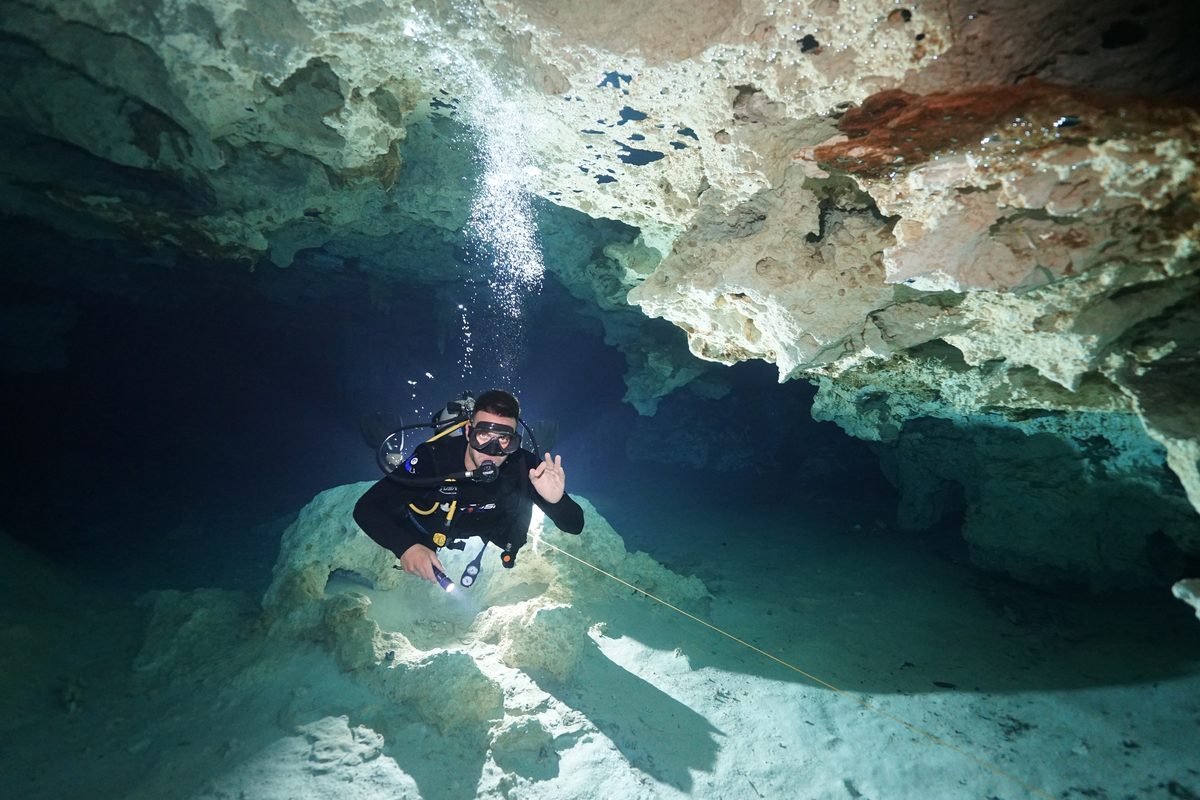
A Dos Ojos cenote dive is one of the most complete cavern diving experiences on the planet — two connected cenotes linked by a system of crystal-clear water tunnels that includes the famous Barbie Line and the Bat Cave. I’ve been diving the Mexican Caribbean for 33 years, and I still bring groups here every week because no matter how many times I do this dive, the light pouring through the “eyes” of turquoise water never stops catching me off guard.
What is a Dos Ojos cenote dive, exactly?
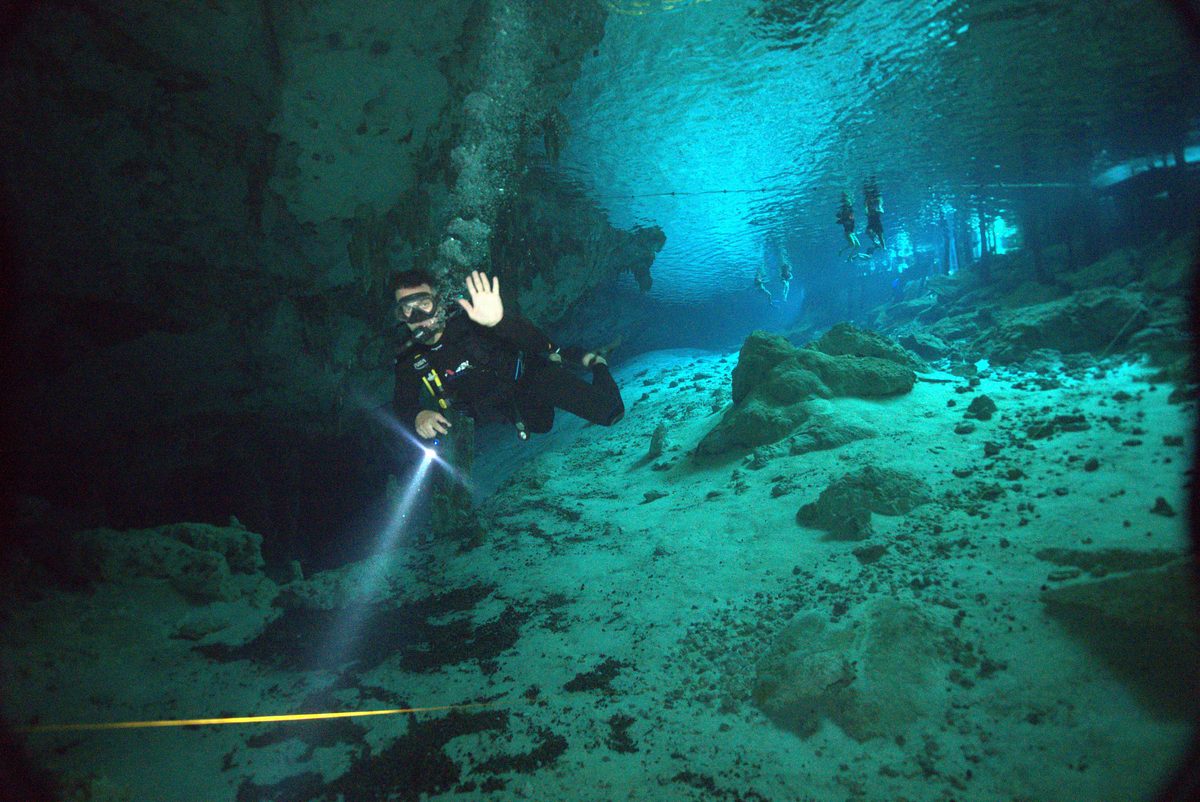
It’s a guided dive through the cavern zone — meaning natural light is always visible — of a system formed by two circular cenotes connected underground. The route covers Barbie Line, known for its stalactites and stalagmites, and Bat Cave, an air pocket chamber home to a resident bat colony. You don’t need any cave certification for this, just Open Water.
The Cavern Zone: why it’s not the same as a cave
This is where I get the most questions, because people mix up “cave” and “cavern,” and they’re really different animals. In the cavern zone of Dos Ojos, you never lose sight of the natural light filtering down from the surface — that’s a hard safety rule, not just an aesthetic choice. You swim past limestone columns formed over thousands of years, back when the cenote was still dry, with shafts of light cutting through the water like spotlights. It genuinely feels like floating through an underwater cathedral. For Open Water certified divers, this zone is fully accessible with an experienced guide — no extra cave training required.
Barbie Line: the most photographed route in the cenote
Barbie Line got its name from a doll someone left behind years ago as a joke, and the nickname just stuck. It’s the most popular route on any Dos Ojos cenote dive because it combines stalactite formations hanging from the ceiling with wide passages where visibility easily tops 30 meters on a good day. The freshwater, naturally filtered through limestone, creates that almost surreal clarity you see in every photo. Navigation-wise, it’s a relatively straightforward swim, which makes it ideal for divers looking for their first cenote experience without feeling boxed in by tight passages.
Bat Cave: the air pocket inside the system
Halfway through the dive, the route leads you into a natural air pocket where you can surface inside the cave itself and look up at a colony of bats hanging from the ceiling, several meters above the water. It catches everyone off guard, even seasoned divers, simply because they never see it coming. The light here is dim and the whole atmosphere shifts — silence, echo, and that distinct mineral smell you only get in caves. After a few minutes taking it in, your guide leads the group back toward the exit, closing out the loop and rounding off the full Dos Ojos cenote dive with that mix of awe and quiet respect these underground spaces tend to bring out in people.
Halocline: the visual effect nobody explains properly
In certain parts of the system, you’ll pass through a halocline — the layer where freshwater meets saltwater seeping in from the sea. Visually, it looks like you’re swimming through oil or frosted glass, since the two densities don’t mix right away and end up bending the light. The first time you see it, it’s genuinely disorienting: some divers instinctively try to “swim slower,” assuming the water has gotten thicker, even though the actual resistance hasn’t changed at all. It’s a phenomenon you’ll also notice on a Chac Mool cenote dive, a site known specifically for its especially pronounced halocline. It’s one of those details that make a Dos Ojos cenote dive feel completely different from a reef dive — here, the geology and chemistry of the water are just as much the main attraction as anything living in it.
What certification do you need for a Dos Ojos cenote dive?
Your Open Water certification is all you need for the cavern zone at Dos Ojos, as long as you’re diving with a guide trained specifically in cave and cavern diving. You won’t need a cavern diver or cave diver card unless you want to push past the natural light zone — something we don’t offer on this route, for safety reasons. If you’re low on logged dives or haven’t been in the water in a while, mention it before the trip so we can adjust the plan and run through a quick buoyancy refresher, since dive control inside enclosed spaces with fragile formations is a different skill set than what you’d use in open water. For divers looking to build on their skills afterward, our Advanced Open Water certification guide covers deep diving, navigation, and other specialties you can add once you’re back on the reef.
Gear and what’s included in the experience
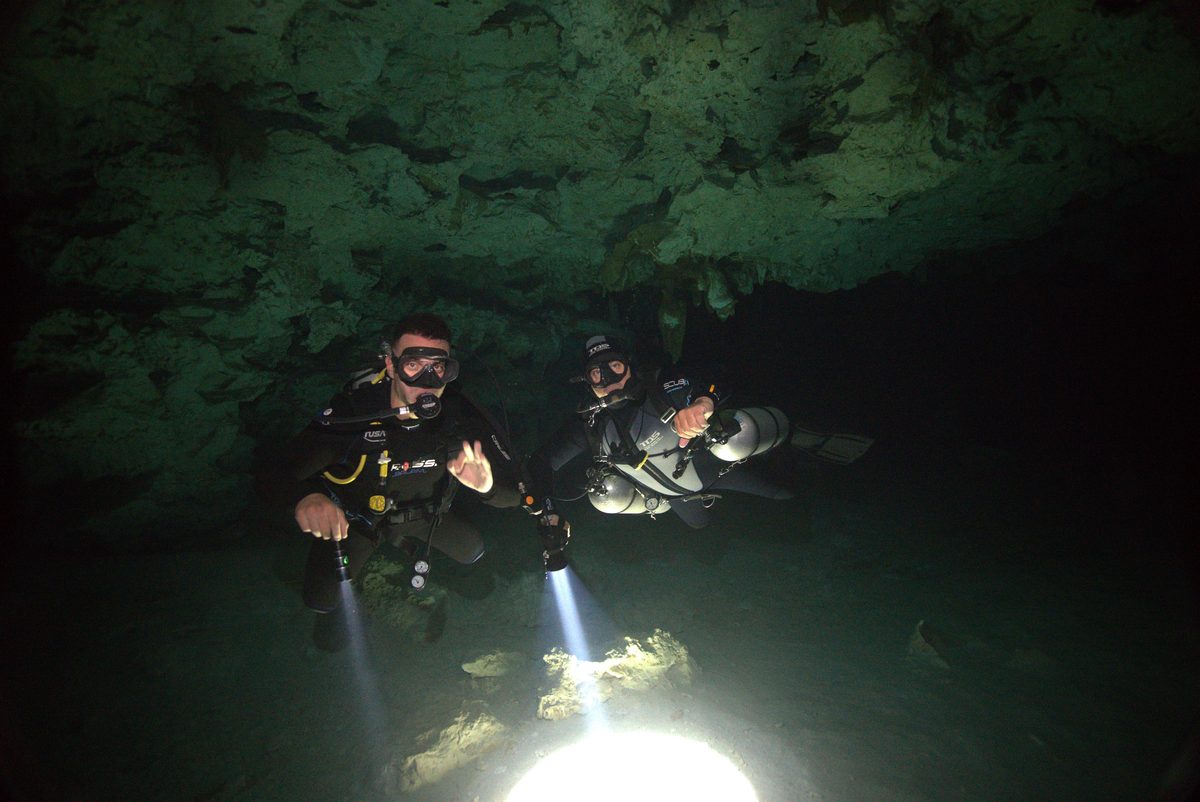
Everything you need for a Dos Ojos cenote dive is included: regulator, BCD, wetsuit, weights, and a dive light, which we use inside the cavern to bring out details in the formations that natural light doesn’t quite reach. We also include a cave-certified guide, two tanks (Dos Ojos is generally dove as two separate dives, one for each “eye” of the system), and ground transportation. You don’t have to worry about hauling or coordinating any loose pieces of equipment — you show up, we get you set, and you’re in the water ready to go.
Logistics from Playa del Carmen
Unlike our ocean dives, where we run our own boat, La Jefa, the Dos Ojos cenote dive happens inland, so transportation is by vehicle from Playa del Carmen. The logistical upside is that you can pair this dive with a reef dive the same day, or on a different day of your trip — including a full Cozumel diving day — without ever changing hotels. If you’re planning another visit and want to explore a different cenote beyond Dos Ojos, the Cenote Chikin Ha dive offers a similarly accessible experience with its own distinct character and formations. We schedule early departures to make the most of the natural light inside the cavern, since mid-morning sun hits the system at a more favorable angle for both photography and overall visibility. Since cenote conditions stay consistent year-round unlike ocean diving, which follows its own seasonal patterns — something we break down in our best time to dive in Playa del Carmen guide — you can book this dive any month without worrying about visibility swings.
Life and formations you’ll encounter
Inside the cenote system, you won’t find tropical reef fish, but you will find geological formations unlike anything on a reef: columns, curtains of stalactites, and tree roots that push through the limestone ceiling in search of water. You’ll also commonly spot small freshwater fish adapted to partial darkness, along with blind shrimp tucked into the deeper shadowed sections. The sensory experience is unlike any reef dive — the silence is nearly total, broken only by your own breathing through the regulator, something many divers describe as meditative, a feeling that also defines the Angelita cenote dive, another must-do system in the region for anyone who’s already fallen for cenote diving.
FAQ: Dos Ojos cenote dive
How long does the Dos Ojos cenote dive last?
Each of the two routes (Barbie Line and Bat Cave) runs 40 to 50 minutes, depending on the group and conditions. All together, including the surface interval between tanks, a Dos Ojos cenote dive takes roughly two and a half hours in the water, not counting transportation from Playa del Carmen.
Is the Dos Ojos cenote dive safe for beginners?
Yes, as long as you hold an Open Water certification and dive with a guide specialized in cave and cavern diving. The cavern zone at Dos Ojos keeps you within visual range of natural light at all times, which significantly lowers the risk compared to deep cave diving with no light exit.
Can I combine a Dos Ojos cenote dive with reef diving on the same trip?
Absolutely — many divers dedicate one day to Dos Ojos and another to the reefs off Playa del Carmen or Cozumel. Since both experiences run out of the same general area, it’s easy to build a combined itinerary without wasting time shuttling between different hotel zones.
Is there a best season for the Dos Ojos cenote dive?
Unlike ocean diving, Dos Ojos is dove year-round with very stable conditions, since freshwater temperature and visibility don’t depend on ocean currents or rainy seasons the way open-water conditions do.
If you want to experience a Dos Ojos cenote dive with a certified guide who knows every corner of the Barbie Line and the Bat Cave, message us on WhatsApp and we’ll build out your full day from Playa del Carmen.
Email: booking@deepmexico.com
WhatsApp: message us on WhatsApp
Need help choosing the right dive outing?
Message us and we will help you compare options, logistics and budget based on your level and your trip.